Prepare your teams for the situations that test their professional composure.
Aggressive customers, internal tensions, transitions, international assignments: concrete reference points to stay effective without burning out.
- Handle verbal aggression and customer harassment with professionalism.
- Act with clarity during change and role transitions.
- Adapt to international contexts and different reference points.
Most training transfers knowledge. We train behaviour.
From 1 October 2026, Japanese law requires employers to act against customer harassment: a clear policy, a consultation channel, a prompt response to every incident. A one-off session is not enough: you need an internal capability that lasts.
The hidden cost of unresolved pressure.
Tension builds quietly: teams compensate, relationships appear functional, the strain accumulates. When the issue surfaces, it already affects performance, engagement and turnover.
Staying calm under aggression takes constant effort, linked to emotional exhaustion (Grandey, 2003). Lasting stress impairs attention and decision-making (Arnsten, 2009).
Dojodozo helps you act before these pressures become costly.
How it works.
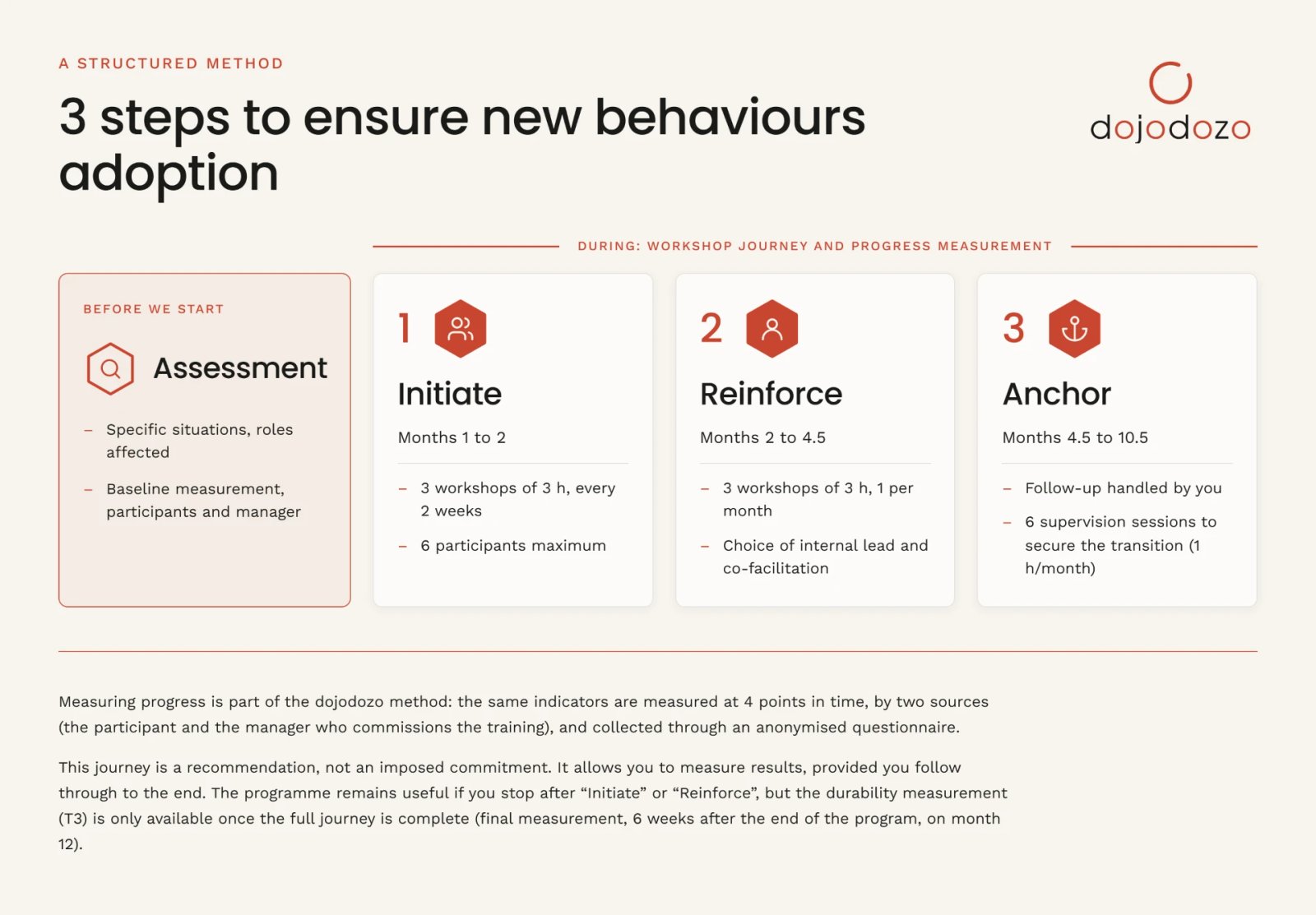
1
First conversation
we frame your needs and your context.
2
Diagnostic
the real situations, with whom, in what format.
3
Programme
workshops or pathway built on these situations.
4
Measurement and follow-up
what you receive, and what stays active afterwards.
Two contexts, one foundation: people rely on behaviours that worked before. We help them practise new ones.
Offer 1 · For customer-facing teams
Customer harassment training: dealing with abusive customers and verbal aggression
Your teams handle two things at once: the customer's problem and the emotional intensity of the exchange. Repeated exposure is exhausting, and how they respond shapes the customer experience.
Not a script. Not a lecture. A practice space.
What your teams practise
- Staying grounded with an aggressive customer
- Acknowledging frustration without accepting abuse
- Setting a clear boundary with verbal self-defence techniques
- Bringing the exchange back to facts and options
- Knowing when to pause, close or escalate
- Recovering after a demanding interaction
On site · French or English · 6 participants maximum
Why in a group: teams rehearse together, give each other real-time feedback and hold each other accountable after the workshop.
An internal referent
chosen by you, no hierarchical link, carries the programme after we leave.
Anonymous data
you only receive aggregated results, never individual answers.
Science-based
COM-B model (Michie et al., 2011), measured in your organisation.
Expected outcomes
- T0 · Before we start
- baseline measurement
- T1 · After Initiate
- concrete options for difficult situations
- T2 · After Reinforce
- teams more present and more confident
- T3 · After Anchor (month 12)
- de-escalating tension becomes a reflex
To get started: an awareness conference for your managers and teams.
Offer 2 · International mobility
Guided Circles – for professionals and families navigating unfamiliar territory
An international assignment can unsettle professional identity, relationships and confidence, for the employee and for their partner. Family adjustment strongly influences whether expatriates stay or return early (Black & Stephens, 1989; Shaffer & Harrison, 1998).
6 group sessions · practice and roleplay on real situations
For your organisation: mobility, partner inclusion, retention.
→ Discover the Guided CirclesA clear boundary between sponsorship and participation.
You fund. The participant owns their process.
You receive participation, progress and aggregated indicators. Never personal content.
Measures concern observable behaviours, never a psychological diagnosis.
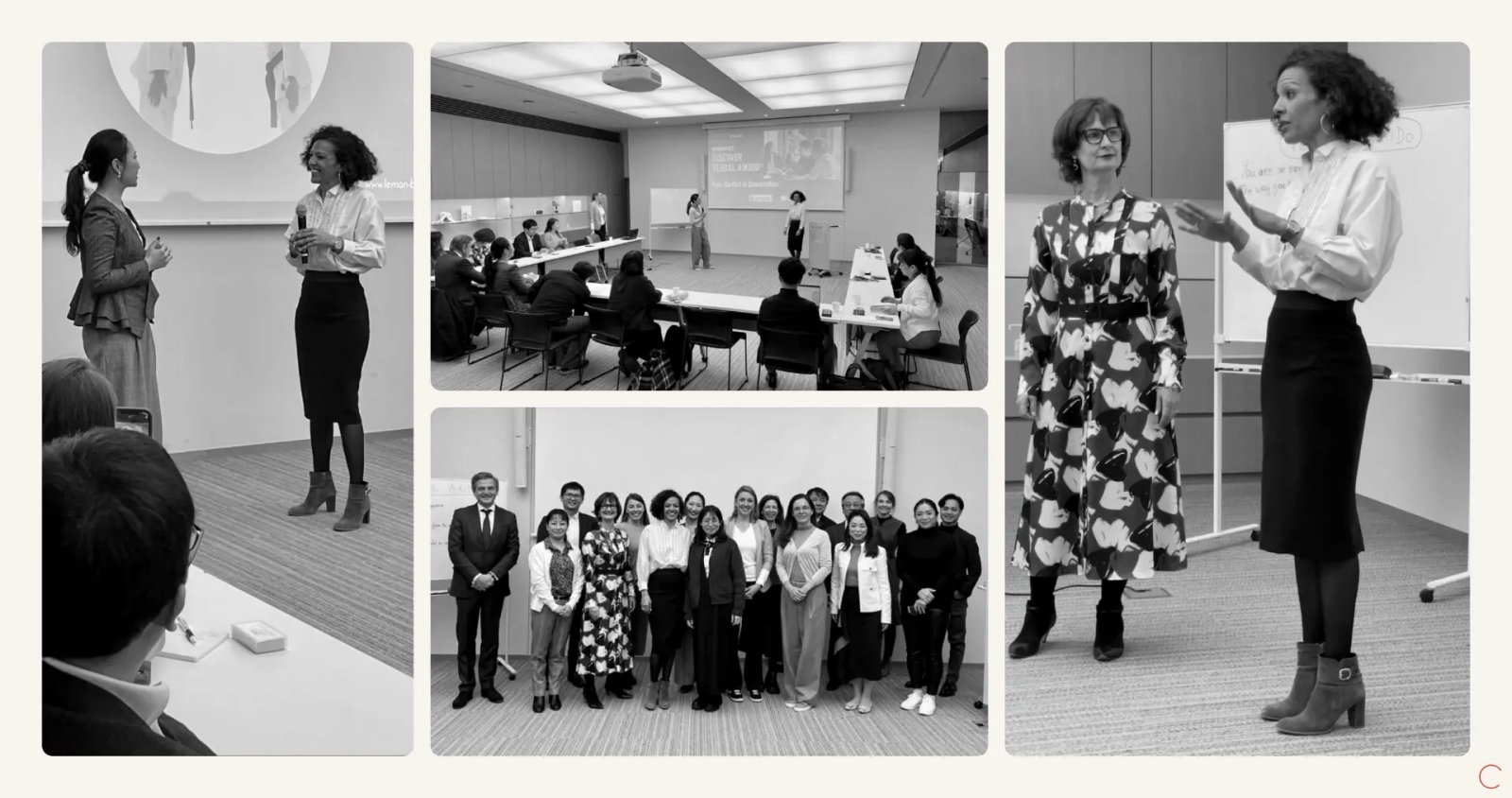
A method already tested in the field.
80+
workshops with French schools in Tokyo and Singapore
10+
workshops for professional networks: French Chamber of Commerce and Industry in Japan, Belux Chamber, FAJ, Innovate'Her
Temple University
ongoing educational projects, Tokyo campus
This proved far more useful than I had imagined. Repeated practice brings something traditional training does not: a lasting change in attitude. My teams are no longer afraid to interact with people who attack them verbally.
Shane Brown, Teleperformance, Customer Service Manager
I learned that listening to a customer's frustration did not mean accepting aggression. Today I can stay professional, set a clear boundary and protect my energy.
Ayumi Nakazawa, Global Insurance, Sales Representative